A World Without Police by Geo Maher
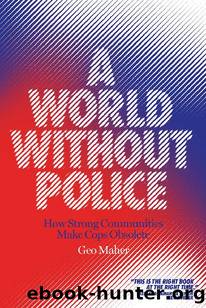
Author:Geo Maher [Maher, Geo]
Language: eng
Format: epub
Publisher: Verso
Published: 2021-08-24T00:00:00+00:00
â
The systems we confront are resilient and deeply entrenched, however, and especially in light of the stalled effort to dismantle the Minneapolis Police Department, we need to remain acutely aware of the many pitfalls that surround and beset the abolitionist project. Just as minor reforms have only increased the legitimacy of the police and made policing more effective, every small and partial move toward abolition can easily become a new part of the system if we are not on guard. Efforts to abolish the death penalty, for example, have ended up strengthening life without parole, or what organizers increasingly refer to as âdeath by incarceration.â For example, Californiaâs Proposition 34, which was narrowly defeated by voters in 2012, was couched in language that, in the words of political theorist Andrew Dilts, reinforced and legitimized âpermanent exclusion, forced labor, more police, more punishment, and more prisons,â thereby âreconfiguring and intensifying the carceral systemâ rather than weakening or dismantling it.36
Similarly, Critical Resistance and INCITE! were among the first organizations to diagnose the ways anti-violence advocacy, especially when taken over and professionalized by state intervention, contributed to what would come to be known as âcarceral feminism.â By separating anti-violence work from its grassroots origins and handing power to the state, this carceral turn isolated the fight against interpersonal violence from the struggle against state violence. The result was movements against policing and prisons that marginalize women of color and demands around gendered and sexual violence, and movements against interpersonal violence that see police and prisons as the only possible protection for women, children, and sexual minorities.37 Debates around sex work have followed a similar trajectory, with carceral feminism manifesting as a vociferous movement against so-called human trafficking. While trafficking is very real, mainstream advocacy often leverages concern for vulnerable populations in a way that reduces all sex workers to victims, or even slaves. Rather than embrace the complex realities of sex workers and their movements, police, governments, Border Patrol and immigration enforcement, and international organizations have embraced the language of human trafficking to increase surveillance and criminalize sex work in ways that only endanger its practitioners.
The George Floyd rebellions sparked nationwide calls to defund the police, and for many, this naturally means redirecting those funds toward social workers, mental health professionals, and schools. As we have seen, however, each of these institutions is increasingly complicit in the broader carceral system, functioning more like the police and handing more people over to prisons every day. As a result, abolitionists today remind us that we must also reimagine welfare institutions as part of a broader abolitionist project. For legal scholar Dorothy Roberts, simply pouring money into social work runs the risk of substituting one punitive system with another. This is especially true of child protective services, which represents not an alternative to the police but an âintegral part of the U.S. carceral regimeâ that is âdesigned to regulate and punish black and other marginalized people.â More money to CPS, in other words, means more surveillance of poor communities of color, more families torn apart, and more parents in prison.
Download
This site does not store any files on its server. We only index and link to content provided by other sites. Please contact the content providers to delete copyright contents if any and email us, we'll remove relevant links or contents immediately.
| Anthropology | Archaeology |
| Philosophy | Politics & Government |
| Social Sciences | Sociology |
| Women's Studies |
The Secret History by Donna Tartt(19128)
The Social Justice Warrior Handbook by Lisa De Pasquale(12199)
Thirteen Reasons Why by Jay Asher(8927)
This Is How You Lose Her by Junot Diaz(6900)
Weapons of Math Destruction by Cathy O'Neil(6290)
Zero to One by Peter Thiel(5816)
Beartown by Fredrik Backman(5772)
The Myth of the Strong Leader by Archie Brown(5517)
The Fire Next Time by James Baldwin(5458)
How Democracies Die by Steven Levitsky & Daniel Ziblatt(5227)
Promise Me, Dad by Joe Biden(5161)
Stone's Rules by Roger Stone(5092)
A Higher Loyalty: Truth, Lies, and Leadership by James Comey(4974)
100 Deadly Skills by Clint Emerson(4936)
Rise and Kill First by Ronen Bergman(4803)
Secrecy World by Jake Bernstein(4762)
The David Icke Guide to the Global Conspiracy (and how to end it) by David Icke(4730)
The Farm by Tom Rob Smith(4518)
The Doomsday Machine by Daniel Ellsberg(4497)
